
Tile Material Comparison Guide
Porcelain, ceramic, natural stone, terracotta, glass and mosaic. Every one of them is the right choice somewhere, and every one of them is the wrong choice somewhere else. This is how to tell which is which before you buy.
The Short Answer
The Choice Turns on Five Things
The name on the box is the last thing that matters. A tile decision is made on five inputs, and if you can answer all five you can pick the material yourself.
- Where it goes. A shower floor, a kitchen floor, a backsplash and a mudroom do not have the same job, and one material cannot be the right answer for all four.
- How much water it sees. Dry, occasionally wet, or standing wet on a regular basis.
- What it has to carry. A person walking across it every day and a heavy appliance sitting on it are different loads.
- The look you want. This is the reason most people are buying tile, and it is a real input, not a soft one.
- What you want to maintain. Some materials need sealing on a schedule. Some need nothing. Both are fine answers, as long as you know which one you are buying.
Read the rest of this page with those five in hand. Every material below is judged against them.
Where The Confusion Starts
Two Families First: Porcelain Is a Kind of Ceramic
Porcelain and ceramic are often set against each other as if they were two unrelated products. They are not. Porcelain is a type of ceramic tile, made by firing the same clay body at a higher temperature so that it vitrifies. That is the whole difference, and it is a big one.
The Water Absorption Numbers That Sort the Family
The water absorption groups in ISO 13006 and ANSI A137.1 sort the whole family. The lower the number, the less the tile takes on.
| Group | Material | What it means for you |
|---|---|---|
| BIa | Porcelain | Absorbs 0.5 percent or less. Fired vitrified, so it never needs sealing for water resistance. |
| BIb | BIb class | Absorbs more than 0.5 percent but no more than 3 percent under ISO 13006. It is not the porcelain (BIa) group, so wet-room grout still gets a sealing plan. |
| BIIa | Glazed ceramic | Absorbs more than 3 percent but under 6 percent. A wall and backsplash material, and it does not go on a floor. |
| BIIb | Glazed ceramic | Absorbs 6 percent to 10 percent. The most porous of the family, and the reason ceramic does not go on a wet floor. |
| AIII | Quarry and terracotta | Absorbs above 10 percent. Genuinely porous, and it will take water unless it is sealed. |
So when a salesperson says porcelain is more water resistant than ceramic, they are right, and the measurement is a number you can ask for. When they say porcelain and ceramic are completely different materials, they are describing the same family.
The Workhorse
Porcelain: Where It Earns Its Keep, and Where It Costs You
Where Porcelain Tile Earns Its Place
Porcelain earns its place in three places: a wet room, a high traffic floor, and a large format tile that has to be big.
It is dense, it does not absorb water, it does not need sealing, and it holds its color. In a wet room that is worth a lot, because the material itself is not the thing that fails in a shower.
What Porcelain Tile Costs You
The costs are honest and they are worth naming before you buy. Porcelain is a harder material, so it takes more time to cut and more skill to set. Edges chip rather than bend, which means a chipped edge on a large piece is a replacement, not a repair. And on a wall or a backsplash, where nobody walks on it, the extra cost is buying a property you will never use.
- Good on: shower and bathroom floors, kitchen floors, mudrooms and entries, laundry rooms, and anywhere the floor gets wet and has to dry.
- Also good on: walls and backsplashes, if the look you want comes in porcelain. It is not a mistake, it is just paying for more than the job needs.
- Watch for: the harder cut. Ask how the piece gets trimmed and what happens to a chip on site, because porcelain does not sand or fill the way ceramic does.
If the tile is going to be 15 inches or more on an edge, porcelain is usually the only material that comes in that size with the color you want. Our large format tile installation page covers what a floor has to be before a big piece goes on it.
The Wall Answer
Glazed Ceramic: The Wall and Backsplash Workhorse
Glazed ceramic has a fired glass surface on a porous body. That surface is easy to wipe clean and easy to look at, which is why it is the default answer for a backsplash and a shower wall. The body underneath is where the water goes, and that is why it does not belong on a floor that gets wet.
Why Ceramic Cuts Easier Than Porcelain
It also cuts and handles more easily than porcelain, which matters on a wall where you are cutting around an outlet and working up to a cabinet line. It is the right material when the tile is on a vertical surface and the floor is a different tile entirely, which is what a good backsplash design does.
- Good on: backsplashes, shower walls, bathroom walls, and any vertical surface that gets splashed.
- Not on: a floor that gets wet, and it is not a good choice for a shower floor. The body absorbs water, and a shower floor is where water sits.
- On a wall, the waterproofing behind it is the system. The tile is a finish. Our guide to what goes behind shower tile goes through the layers.
The Look, And The Bill That Comes With It
Natural Stone: Marble, Travertine, Slate, Quartzite
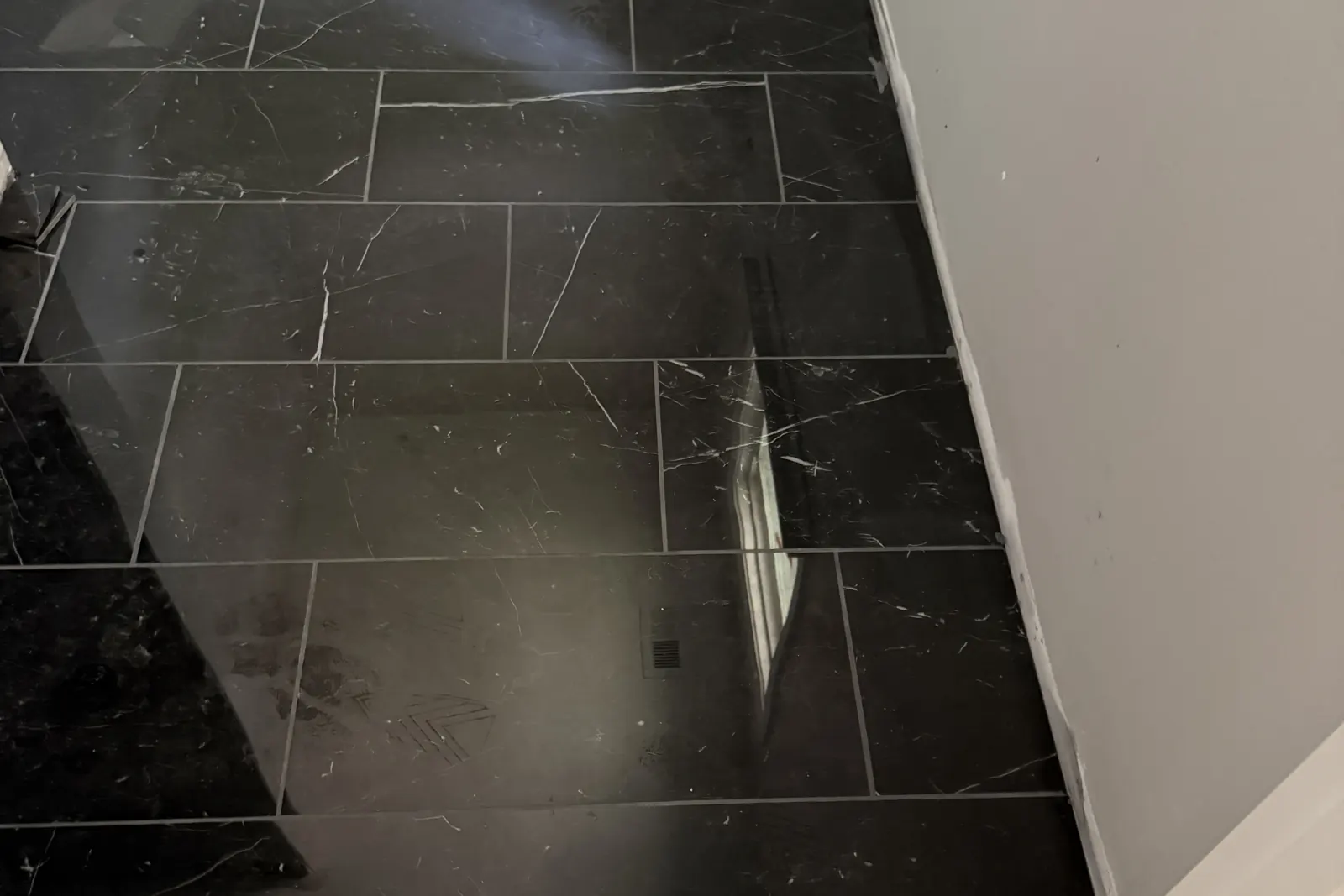
Stone is the reason most people fall for tile in the first place, and it earns the reaction. Every piece is different, the surface is softer and more tactile than a fired one, and it takes a polish that reads as expensive in a way no glaze does.
A Natural Stone Floor Asks for a Stiffer Base
The bill for that look is prep and maintenance. Stone is rigid and brittle, and it is heavy, so the floor under it has to be better than the floor under a 4 by 4 tile. TCNA calls for L/720 over wood framing when the finish is stone, and the Marble Institute of America makes the same recommendation for stone installations. ANSI A108.02 sets the flatness tolerance for natural stone at an eighth of an inch in 10 feet with no more than a sixteenth of an inch in 2 feet, measured from the high points with a straight edge. Our guide to L/360 and L/720 explains what those numbers mean for a floor.
Sealing and Slip Ratings Before You Buy Stone
Maintenance is the other half. Stone is porous, so it takes on water and it takes a sealer, and in a wet room it has to be sealed and resealed on a schedule with the grout beside it sealed too. And a polished or honed floor is a separate question from sealing: polished stone is slippery when it is wet, and it often tests below the wet DCOF of 0.42 measured under ANSI A326.3. Ask for that number on the exact finish, not on the material name.
- Good on: a bathroom floor, a entry or mudroom, a fireplace surround, a countertop tile, and anywhere the look is the point.
- Ask before you buy: the wet slip number on the exact finish, and what the sealing schedule is for that stone in that room.
- Marble-look porcelain is a different product. It is fired vitrified, absorbs 0.5 percent or less, and never needs sealing. It gives you the look of marble without the porosity of marble.
Variation Is The Product
Terracotta, Quarry and Handmade Tile
These materials are porous by design, and nobody who buys them is expecting a matched set. That variation is the point. Zellige and handmade tile are made in a kiln and they come out slightly different, in size, in color and in surface, and a wall of them reads as a hand-made surface rather than a repeat.
Where the Craft Goes in Handmade Tile
The craft is in the install, not the box. Sorting and blending by hand so the wall has a deliberate distribution rather than a random one, and letting a little more mortar show behind a handmade edge, is what makes the surface look right. Our custom tile installation page covers that work.
- Good on: a backsplash, a shower wall, a floor in a warm dry room, and anywhere the variation is the reason for buying it.
- Know before you buy: it absorbs water, so it needs sealing and it needs a substrate that is ready for it.
- Quarry tile is the old, dense, unglazed floor tile, and it is a genuinely good wet room floor when it is rated for it.
The Big Piece
Porcelain Slab and Large Format
A large piece means fewer grout joints. Fewer grout joints means less to clean, fewer places for grout to crack or to wear, and a flatter visual surface. It also means the floor has to be flatter and the work has to be more precise, because there is less room to hide a problem.
The 15-Inch Edge That Decides the Prep
The threshold that matters is 15 inches on an edge. At that size ANSI A108.02 tightens the flatness tolerance, and large format is also where leveling clips earn their keep, because a big piece sitting on the high points and rocking on the low ones is exactly what shows up as lippage.
- Good on: a large open floor, a kitchen with long runs, and a room where the sightline matters.
- Costs you: a flatter floor, more leveling clips, more careful cuts, and a slower install.
- Small rooms are harder. Cuts get tight near walls and fixtures, and a small floor with one big piece in it is mostly cuts.
The Accent
Glass and Mosaics
Glass tile does something no other material does. It takes light and moves it, so a shower wall behind it looks deeper than the tile is. A mosaic in a niche or a band picks up the same light across dozens of small pieces, so it reads as texture rather than as a grid.
The Setting Is What You Pay For
Both are set by hand, in small pieces, and the setting is what you are paying for. Glass has to be cut cleanly because a chipped edge shows, and the pieces have to be set so the face sits flat in the mortar rather than floating on it. That is skilled work and it is why the accent is worth paying for and the whole wall is not.
- Good on: a shower wall, a backsplash band, a niche, and a floor where you want sparkle underfoot.
- Careful on a shower floor. Glass is slippery when wet, and a shower floor is where slip resistance matters most. Ask for the wet DCOF number.
The Part People Skip
What Each Material Asks of What Is Underneath It
The material is the last decision. What is under it is the first one, and it is decided by the material you picked. A dense, rigid, heavy tile on a soft floor is a cracked floor, and a porous material on a floor that holds water is a floor that goes soft underneath.
- The setting material follows the tile. Thinset is the adhesive on a floor and a wall. Mastic is the older material, and it is the one that failed the floors we get called to look at, so it is not what we set.
- Backer board or a membrane, decided by the room and the old floor. Cement board adds stiffness and does not rot. An uncoupling membrane such as DITRA isolates the tile from the movement of the floor, and in a remodel it is what lets the old floor stay where it is.
- Waterproofing is a system, and in a wet room it is the system. A bonded membrane such as Schluter-KERDI, with the corners turned and the drain lapped, is what keeps water out of the wall. A wet room tile job without one is a decoration.
- A rigid, heavy material asks more of the framing. That is what L/360 and L/720 are about, and it is why the framing gets checked before the tile is picked.
Our guide to preparing a subfloor for tile goes through the substrate in detail, and what goes behind shower tile covers the wet room layers.
Room By Room
Which Material For Which Room
The same five inputs, applied to the rooms people actually tile.
| Room | First choice | Second choice | Why |
|---|---|---|---|
| Shower wall | Porcelain or ceramic | Glass or mosaic accent | Vertical surface, splashed not walked on. The waterproofing behind it is the system. |
| Shower floor | Small format porcelain or mosaic | Quarry tile, if rated for it | Slip resistance and a slope to the drain. A shower floor is not a flat floor. |
| Kitchen floor | Porcelain | Natural stone | Spills, grit and dropped pans. Dense, non absorbent, and it needs a floor that carries it. |
| Backsplash | Ceramic | Glass, mosaic, zellige | A vertical surface where the look is the point. Easier to cut, and nothing walks on it. |
| Mudroom or entry | Porcelain or quarry | Slate-look or wood-look porcelain | Wet from outside. It has to dry, and the base under it has to be able to. |
| Countertop | Porcelain or stone tile | Marble, travertine | A flat, square, waterproof base with a full bed of thinset. The fabricator cuts the piece. |
The shower rows are the short answer. For the longer version on the wet room specifically, our guide to the best tile for a shower covers the floor and the wall separately, with the wet DCOF number and the absorption groups.
How This Works
Who Buys the Tile, and Who Sets It
You buy the tile and we set it. We do not sell tile and we do not supply it, so there is no version of this where the material on your floor came from us. That also means the tile is yours, it is chosen by you, and the estimate is about setting it, not about a package.
Daniel sets all of it, with his own crew. There is no subcontractor on your job. The work carries a 1-year written workmanship warranty, and Dmtilellc is a registered Connecticut contractor, CT HIC #0706534, which is a registration rather than a trade licence, because Connecticut issues no tile licence.
Before You Buy
Five Questions to Ask in the Showroom
These five are the ones that change what you buy, and all five have a written answer behind them.
- Is it rated for this room? Ask what the material is rated for on a floor, not in general. Glazed ceramic is a wall answer.
- What is the water absorption group? ISO 13006 and ANSI A137.1 sort it. Porcelain at 0.5 percent or less never needs sealing for water resistance.
- Is the trim available? Bullnose, Schluter profiles, and matching edges have to exist in the color you picked, or the outside corner and the transition are the weak point.
- How much shade and lot variation is there? Get the lot number and buy from one lot. This is the single most common reason a floor looks wrong after it is installed.
- What grout joint width is this tile made for? ANSI A108.02 has the rules on joint width, and a tight joint on a warped edge is a cracked tile.
The grout choice goes with it. Our grout color guide covers cement, epoxy and natural stone and how they behave.
Frequently Asked Questions
Tile Materials - Questions
They are not competing. Porcelain is a type of ceramic tile, fired at a higher temperature so it is denser and absorbs 0.5 percent or less under the ISO 13006 groups. That density is why porcelain goes on floors and in wet rooms. Regular glazed ceramic is softer, easier to cut, and cheaper, and it is the right choice on a wall or a backsplash where it is never walked on wet. If you want the answer for a shower, the material guide on this page links to our shower tile guide, which answers it properly.
Porcelain or natural stone, on a floor that is flat and stiff enough to carry it. Kitchen floors get spills, grit tracked in from outside, and dropped pans, and they get wet in ways a bathroom floor does not. Porcelain is dense and does not absorb water, and it handles that. The floor underneath matters more than the tile on top of it, so the subfloor has to be checked before the tile is picked, and a kitchen floor over a soft or uneven subfloor will crack the tile no matter which one you buy.
Real marble, travertine, slate and limestone are porous. They take on water, and in a wet room they need sealing and resealing on a schedule, with the grout beside them sealed too. Porcelain is fired vitrified and absorbs 0.5 percent or less, so it never needs sealing for water resistance. A polished floor is a separate question from sealing: polished stone is slippery when it is wet, and a polished or honed floor often tests below the wet DCOF of 0.42 measured under ANSI A326.3. Ask for that number on the exact finish you are buying.
You can, but it changes the job rather than the room. Large format tile means fewer grout joints, which people like, and it also means the floor has to be flatter. ANSI A108.02 tightens the flatness tolerance for tile with an edge of 15 inches or more, and for natural stone, to an eighth of an inch in 10 feet with no more than a sixteenth of an inch in 2 feet, measured from the high points with a straight edge. Bigger tile on a floor that misses that tolerance shows up as lippage, which you feel underfoot and see under raking light. In a small room the cuts get tight near the walls and the fixture.
It is a good accent and it is a poor floor. Glass tile is a good choice on a shower wall, where it is a surface you touch with a towel and see close up, and it takes light in a way no other material does. On a shower floor it is slippery, and it is the floor where slip resistance matters most. For the floor, a tile rated for that wet surface is the right call, and our shower tile guide goes through the choices for the floor and the wall separately.
A dense, slip-resistant tile, set on a base that takes water without moving. Porcelain and quarry tile are the usual answers. The floor underneath is the deciding part. A mudroom floor gets wet from outside, and water under a floor that cannot dry is how a subfloor gets soft, so the base, the slope and the way the water leaves have to be right before the tile is chosen. Slate-look and wood-look porcelain are popular because they do not need sealing, but the base under them has the same rules as any other floor.
Still have questions? Call us at (860) 990-2332
Where this work gets done
Large format tile installation, Custom tile installation by Dmtilellc across Connecticut. Ask for a free estimate.
Tell Us the Room, and We Will Tell You What Tile Fits It.
If you are in New Britain, Berlin, Newington, Plainville, Farmington, Avon or a nearby Connecticut town and need tile installation, bathroom remodeling, shower waterproofing, backsplash work, or floor tile installation, contact Dmtilellc today. Free estimates available.