
What Goes Behind Shower Tile, and Why It Decides Whether the Shower Lasts
The tile is the part you look at. It is almost never the part that fails. What decides whether a shower lasts is the layer stack underneath it, and one layer of that stack is the reason water problems get expensive.
The Short Answer
The Tile Is Almost Never the Part That Fails
What decides whether a shower lasts is the layer stack underneath the tile, and one layer of that stack is the reason water problems get expensive.
The Stack, Bottom to Top
Four Layers, and One Nobody Sees
The Subfloor
The wood or concrete under everything. If it gets soft, it is usually too late to save it cheaply.
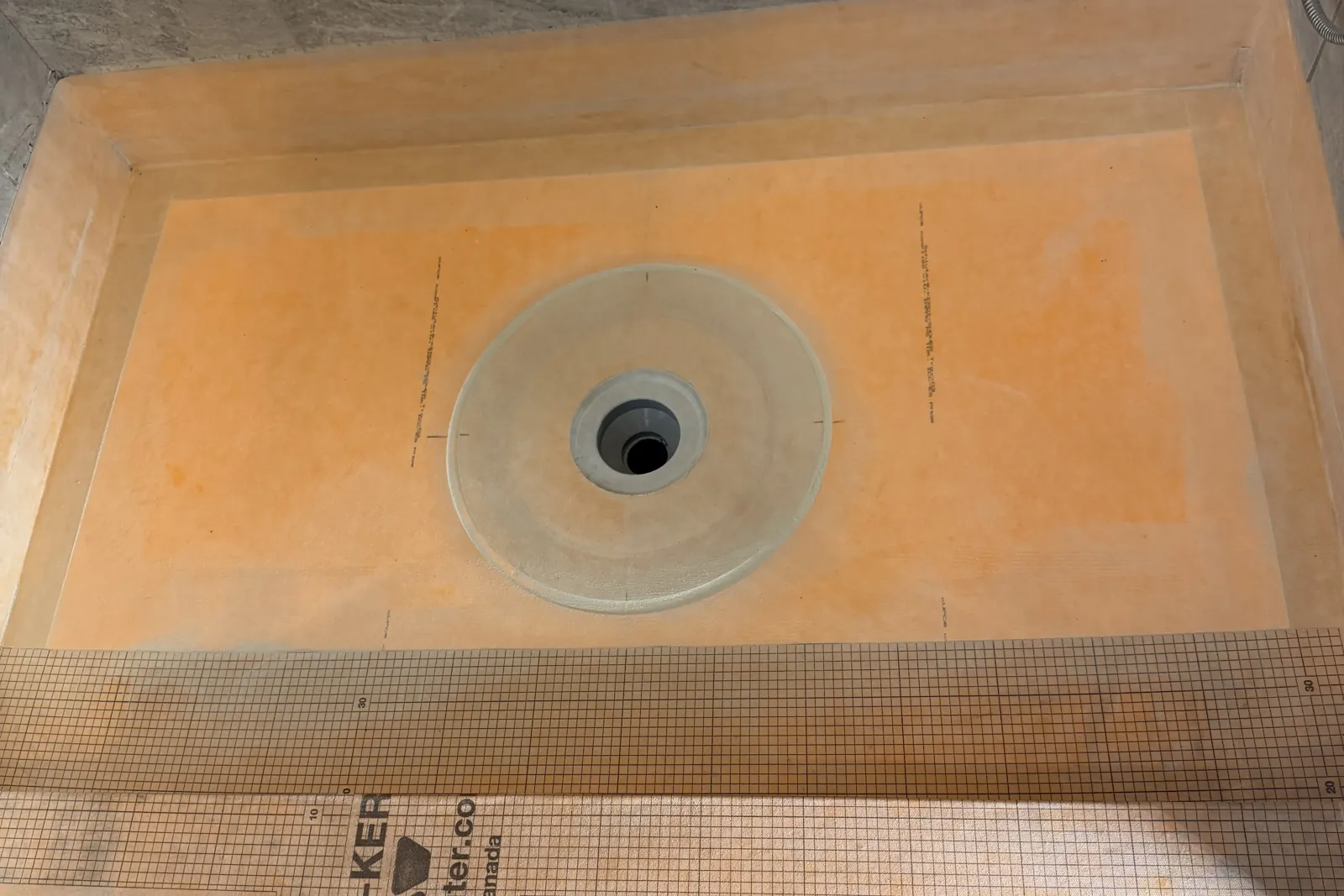
The Pan
A mortar bed, or a bonded membrane system. This is what catches water and carries it to the drain. Code requires a watertight receptor, a curb at least 2 inches high (IRC P2709.1), sloped to the drain.
The Waterproofing Layer
A separate membrane. This is the layer people skip and then wonder why.
Tile and Grout
The finish. And here is the part that surprises people: tile and grout are not waterproof. Cement grout is porous by design. That is exactly why epoxy grout exists.
There is also backer board behind the wall tile. Cement board is water-resistant, not waterproof, and it needs its own separate membrane plus taped and sealed seams.
Two Legitimate Systems
There Are Two Honest Ways to Build This, and Neither One Is a Mistake
One is cement board with a separate membrane. Another is a bonded system like Schluter-KERDI, where the membrane is physically bonded to the substrate, so there is no unbonded gap for water to travel through. Code does not name any brand. It does not require KERDI or any specific product. What it requires is a watertight receptor.
The honest difference is that a bonded system leaves no unbonded gap, where cement board adds one more seam-dependent step, and the seams are where the risk lives.
What Code Actually Says
- Code requires a watertight receptor.
- Code does not name any brand or product.
- Code requires a curb at least 2 inches high, sloped to the drain.
- A bonded system leaves no unbonded gap for water to travel through.
The 15 Minute Code and the 24 Hour Practice
Code Asks for 15 Minutes. We Hold 24.
Connecticut adopted the 2022 Connecticut State Building Code, based on the 2021 IRC, which says at P2503.6 that the shower receptor is filled with potable water to a depth of not less than 2 inches measured at the threshold, and the water held not less than 15 minutes with no evidence of leakage.
Schluter's own installation handbook recommends waiting 24 hours minimum before water testing. We hold 24 hours. Code asks for 15 minutes (IRC P2503.6). We do 24 because that is what the manufacturer asks for, and because it is the last chance to see a leak before tile covers it up. The extra time is our practice, not a code requirement. We would rather you know that.
The Pan and the Wall
The Pan and the Wall Are Two Different Problems
This is the single most useful thing a homeowner can be told, and almost nobody says it. If water is coming through the pan, tile usually has to come up, and it is expensive. If it is coming through the wall or the grout, it is often repairable. You cannot tell which one you have by looking. A damp floor tile and a damp wall tile can come from opposite ends of the same shower. That is why guessing before opening something is expensive.
What the Flood Test Proves
A Passed Flood Test Is Not a Clean Bill of Health for the Shower
A flood test proves one thing: the pan holds water over a short window. That is genuinely valuable. It does not test the walls. It does not test the shower valve, the caulk lines, or the grout. It does not test long-term seepage, because 15 or 24 hours is not a year. A passed flood test is good news about the pan. It is not a clean bill of health for the shower.
Efflorescence
Efflorescence Is a Readout, Not a Stain
White powdery salt on a tile surface or in a grout line is not a cosmetic problem. Salt only reaches the surface when water is moving through the assembly. It is showing you where the water is going. People want it scrubbed off. Understand where it came from first.
Proof You Can Legitimately Ask For
What You Can Legitimately Ask for as Proof
- Ask to see the flood test being filled and timed, not just told about.
- Ask what membrane and system is going in, and whether it is bonded.
- Ask how long they hold it and why they chose that number.
- Ask what the plan is if the pan fails during the job.
- Ask what happens with the wall if the pan has to come out.
Symptoms and Causes
Tile and Grout Are Rarely the Real Cause
When people call about a shower problem, they usually point at the tile. Cracked tile, cracked grout, a soft patch, a stain. Those are symptoms. The water got in underneath or alongside them. Fixing grout on a shower with a failed pan does nothing. It looks better for a while and the water is still going where it was going.
Google Reviews
What Connecticut Homeowners Say
Marek Pawulski
November 2026
Daniel did some tile work for me and I couldn’t be happier with how everything turned out. Absolutely amazing work and craftsmanship. He showed up on time, was very professional throughout the whole job, and did a fantastic job. You can tell he takes pride in his work and pays attention to the little details. Good, reliable contractors aren’t always easy to find, and Daniel is definitely one of them. The quality of the work was excellent, everything was done right, and he was worth every penny. I will definitely use him again and wouldn’t hesitate to recommend him to anyone looking for quality tile work. Highly recommend! Daniel, thank you so much for getting the job done on short notice.
Response from the owner
Thank you so much for taking the time to share such a detailed review! It was a pleasure working with you, and I truly appreciate your kind words and trust. I’m glad you’re happy with the finished work and that I could get everything done on short notice. I look forward to working with you again!
Anne Hope
November 2026
Daniel does amazing work, Very professional, and great prices! I would highly recommend Daniel to anyone that is seeking great work and a great price!
Response from the owner
Thank you so much for the kind words and recommendation! We truly appreciate your support and are glad you were happy with our work, professionalism, and pricing!
Autumn
November 2026
Rated 5 stars, no written review.
Frequently Asked Questions
What Goes Behind Shower Tile: Questions
Four layers. The subfloor, the pan, the waterproofing membrane, and the tile and grout on top. There is also backer board behind the wall tile. The layer almost nobody sees, the waterproofing, is the one that decides whether the shower lasts.
No. Cement grout is porous by design, which is why epoxy grout exists. Water moves through grout and through the grout joints, and that is how it reaches the membrane behind. That is not a defect in the install. It is a property of the material.
Code asks for 15 minutes (IRC P2503.6). We hold it 24, because that is what the manufacturer's installation handbook asks for and because it is the last chance to see a leak before tile covers it. Ask any contractor for their number, and ask why.
Sometimes. If the water is coming through the wall or the grout, it may be repairable without taking the shower apart. If it is coming through the pan, the tile usually has to come up. That is the difference we can actually see, and it is the first thing we check.
Still have questions? Call us at (860) 990-2332
Where this work gets done
Shower waterproofing, Shower tile installation by Dmtilellc across Connecticut. Ask for a free estimate.
Want to Know What Is Behind Your Shower Tile? Let's Open It and Look.
If you are in New Britain, Berlin, Newington, Plainville, Farmington, Avon or a nearby Connecticut town and need tile installation, bathroom remodeling, shower waterproofing, backsplash work, or floor tile installation, contact Dmtilellc today. Free estimates available.