
Marble and Stone Installation, New Britain & Across Connecticut
Marble, travertine and granite set on a substrate measured for flatness and deflection, with the sealing and the movement joints handled before we start.
Service Details
Marble and Stone Installation Done Right the First Time
What Stone Asks of the Substrate
Stone is the least forgiving finish we set. It has no forgiveness in it: it does not flex, it does not span a dip, and it hides nothing, so what it needs has to be true before the first piece is set. ANSI A108.02 sets the flatness tolerance for natural stone, and for any tile with an edge of 15 inches or more, at an eighth of an inch in 10 feet with no more than a sixteenth of an inch in 2 feet, measured from the high points with a straight edge. Over a wood-framed floor, stone is held to L/720, the figure the Tile Council of North America and the Marble Institute of America both call for. And where the stone meets something that moves, a cabinet, a wall, a different material, that joint gets a movement profile and silicone, not grout.
Real Stone vs Marble-Look Porcelain
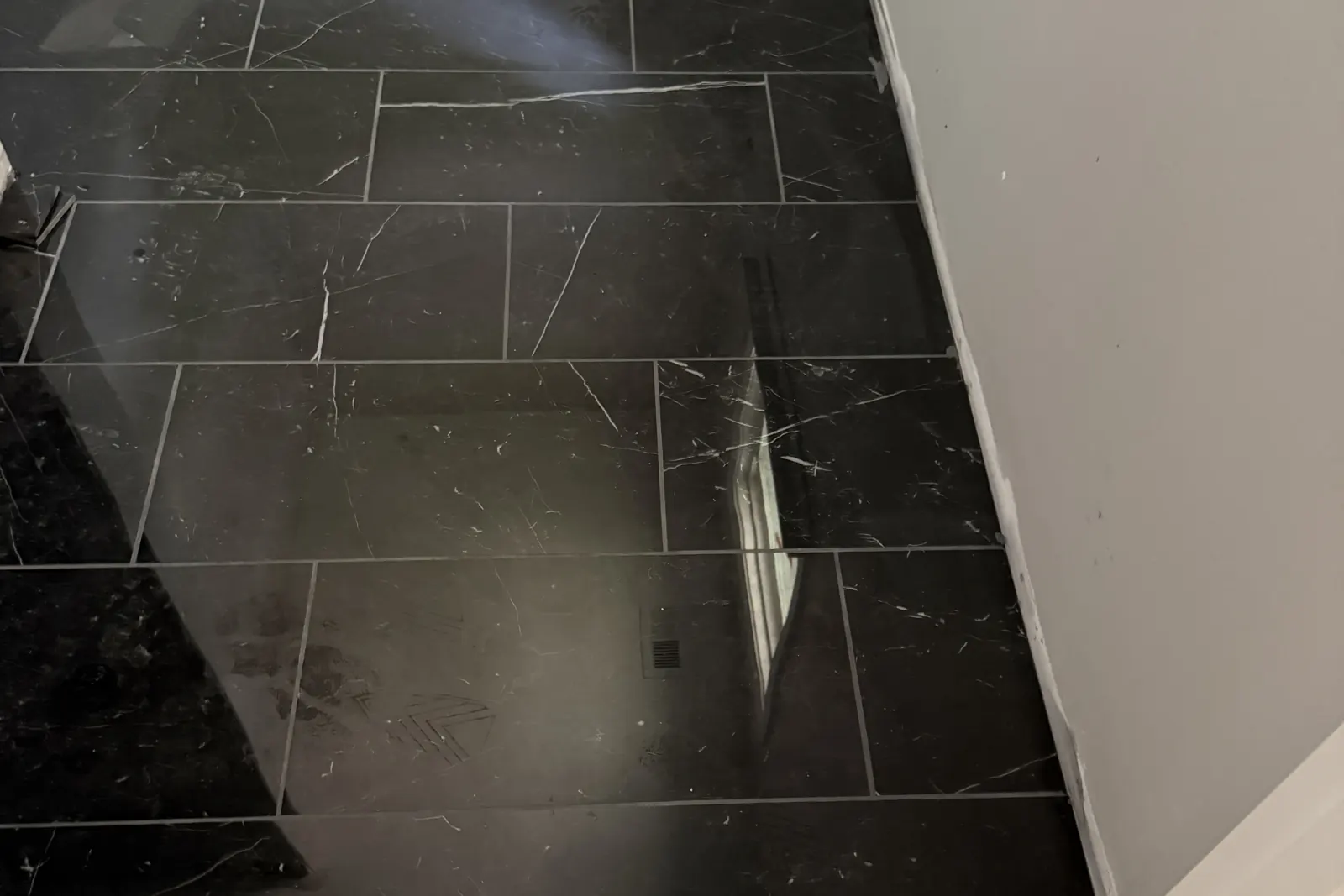
Real marble and travertine are not marble-look porcelain, and the difference shows up in the first year. Marble-look porcelain is fired vitrified, absorbs 0.5 percent or less under the ISO 13006 groups, and never needs sealing for water resistance. Real stone is porous. It takes on water, it takes a sealer, and in a wet room it has to be sealed and resealed on a schedule, with the grout beside it sealed too. A polished floor is a separate problem: it is slippery when it is wet, no floor tile is slip proof, and polished or honed stone often tests below the wet DCOF of 0.42 measured under ANSI A326.3. Ask for that number on the exact finish.
Where the Stone Goes
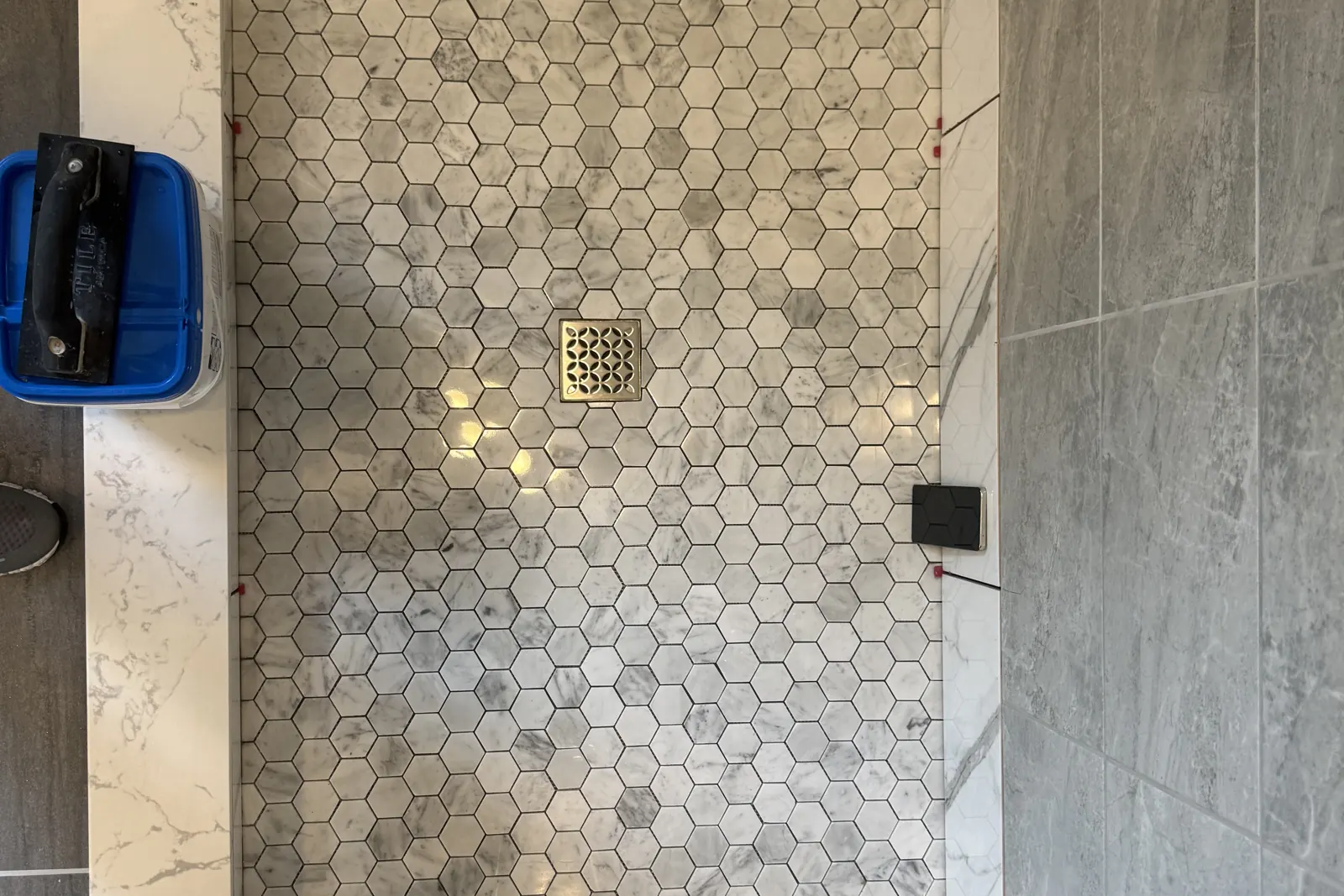
Where the stone goes decides the prep, not the other way round. In a wet room, the floor is not a flat floor: it slopes to the drain over a pan under a bonded waterproofing system, and it is flood tested before anything is set. Code asks for 15 minutes on that test under the 2022 Connecticut State Building Code, and we hold 24. On a floor, the substrate has to carry the weight and stay flat, so the framing is checked against L/720 and the surface is leveled before setting. A countertop needs a flat, square, waterproof base with a full bed of thinset and no spot setting. A wall needs taped and sealed backer board, and a stone wall on a house that settles wants more care than a stone backsplash.
Who Sets It
Daniel sets all of it: marble, all stone work and all tile work, with his own crew. Nothing is handed to a subcontractor. What we need from you is simple. The stone bought and on site, the pattern and the grout color decided, and the room opened up so the floor can be measured and checked for movement. We look before we set, and if the floor cannot carry what you picked we say so at the estimate rather than after the stone is down. It is 10+ years of tile work in Connecticut behind that, and we are rated five stars on Google. Every job carries a 1-year written workmanship warranty, and we are a registered Connecticut contractor, CT HIC #0706534, so that number is verifiable in the state HIC lookup.
Before you book, read what L/720 means for a stone floor. It is five minutes and it saves guessing.
In New Britain we set marble, travertine, granite and slate on a substrate measured for flatness and deflection, with the movement joints and the sealing handled before the first piece.
What You Get
- Flatness measured to 1/8 in 10 feet for stone, before the first piece
- L/720 framing check for stone over wood floors
- Movement profiles where stone meets a wall or a cabinet
- Sealing scheduled for the stone, and the grout beside it sealed
- You buy the stone, we set what you bought
- 1-year workmanship warranty, registered **CT HIC #0706534**
Marble and Stone Near You
Marble and Stone Installation Near You
We provide marble and stone installation throughout Connecticut, with dedicated pages for the communities we serve. Select your town to see local project considerations, neighborhoods and service information.
Google Reviews
What Homeowners Say About Our Marble and Stone Work
Marek Pawulski
November 2026
Daniel did some tile work for me and I couldn’t be happier with how everything turned out. Absolutely amazing work and craftsmanship. He showed up on time, was very professional throughout the whole job, and did a fantastic job. You can tell he takes pride in his work and pays attention to the little details. Good, reliable contractors aren’t always easy to find, and Daniel is definitely one of them. The quality of the work was excellent, everything was done right, and he was worth every penny. I will definitely use him again and wouldn’t hesitate to recommend him to anyone looking for quality tile work. Highly recommend! Daniel, thank you so much for getting the job done on short notice.
Response from the owner
Thank you so much for taking the time to share such a detailed review! It was a pleasure working with you, and I truly appreciate your kind words and trust. I’m glad you’re happy with the finished work and that I could get everything done on short notice. I look forward to working with you again!
Anne Hope
November 2026
Daniel does amazing work, Very professional, and great prices! I would highly recommend Daniel to anyone that is seeking great work and a great price!
Response from the owner
Thank you so much for the kind words and recommendation! We truly appreciate your support and are glad you were happy with our work, professionalism, and pricing!
Autumn
November 2026
Rated 5 stars, no written review.
Frequently Asked Questions
Marble and Stone Questions, Straight Answers
Daniel does, and he does it with his own crew. Marble, all stone work and all tile work is what we do. There is no subcontractor on your job and no third-party installer we hand the work to, so the person who measures your floor is the person setting the stone, and you deal with one company from the estimate through the final clean-up.
Two numbers. ANSI A108.02 tightens the flatness tolerance for natural stone, and for tile with an edge of 15 inches or more, to an eighth of an inch in 10 feet with no more than a sixteenth of an inch in 2 feet. Over wood framing, stone is held to L/720, the figure the Tile Council of North America and the Marble Institute of America both call for. We measure with a straight edge.
Real marble is porous, so it takes on water, it takes a sealer, and in a wet room it has to be sealed and resealed on a schedule. Marble-look porcelain is a different product: porcelain is fired vitrified and absorbs 0.5 percent or less under the ISO 13006 groups, so it never needs sealing for water resistance. Ask which one you are buying, then plan the sealing around it.
When it is wet, it can be, and no floor tile is slip proof. The number that matters is the wet DCOF, measured under ANSI A326.3, where 0.42 is the threshold for a level interior floor that gets walked on wet. A polished or honed stone floor often tests below that, and a shower floor is not a flat floor, it slopes to the drain. Ask for the wet number on the exact finish.
Each surface asks for something different. A wet room wants a slope to the drain, a bonded waterproofing system under the pan, and a flood test before any tile goes down. A floor wants a substrate that carries the weight and stays flat. A countertop wants a flat, square, waterproof base and a full bed of thinset. A wall wants taped and sealed backer board, and more care on a house that settles.
Most stone failures are substrate failures. A floor that moves cracks stone, a surface out of plane gives you lippage, and a wet room without a membrane behind it lets water into the wall. We check those first and tell you what we find before setting. The installation carries a 1-year written workmanship warranty, and it covers our work, not the stone, and not the resealing it needs over the years.
Still have questions? Call us at (860) 990-2332
Guides
Marble and Stone Guides
How this job runs, what moves the price, and where it usually goes wrong.
Technical
L/360 and L/720: What They Mean for Your Floor
What deflection is, what the L number means, and why a floor over a long joist span needs one number and not the other. The most useful thing a tile contractor knows that a homeowner does not.
Technical
Preparing a Subfloor for Tile
What a subfloor has to be before tile goes on, the common failures, and the tile problems that no amount of good tile can fix.
Materials
What Tile Holds Up in a Shower
Porcelain against ceramic against stone in a wet room, slip resistance, and why the pan and the wall behind it matter more than the tile you pick.
Permits
Do I Need a Permit for a Bathroom Remodel in Connecticut?
What the state code exempts, what needs a trade permit, and why a tile job and a plumbing job are not the same job. Read this before you pull anything off a wall.
How we work
Our Tile Installation Process, Step by Step
The whole sequence, from the first visit to the last silicone joint. Substrate prep, waterproofing, layout, setting, grout. No steps skipped.
Ready for Marble and Stone? Get Your Free Estimate.
If you are in New Britain, Berlin, Newington, Plainville, Farmington, Avon or a nearby Connecticut town and need tile installation, bathroom remodeling, shower waterproofing, backsplash work, or floor tile installation, contact Dmtilellc today. Free estimates available.